To keep the public water supply safe from contaminated or polluted water that could be introduced back into the water system through backflow from the customer’s plumbing system, Carefree Water enforces a backflow prevention program in compliance with Arizona Administrative Code on Backflow Prevention (R18-4-215).
Approved backflow prevention assemblies are required to be installed on plumbing systems that have a risk of backflow or cross connection. Customers must have their backflow prevention assemblies tested and inspected annually and are responsible for hiring a certified backflow prevention tester to inspect, test, and if necessary, repair their backflow assembly
Frequently Asked Questions
|
What is Backflow?
Backflow is the undesirable reversal of flow that can bring contaminated or polluted water through a cross connection and back into the piping of a water system. Carefree Water’s distribution system is designed to keep water flowing to the customer. However, when hydraulic conditions within the water distribution system change from “normal” flow conditions, water flow can be reversed.
|
What is Cross-Connection?
A cross-connection is an actual or potential physical connection between a potable water supply and a nonpotable water supply, though it is possible to introduce contaminants or pollutants into the drinking water. An example of a cross-connection would be a garden hose submerged in a chemical dispenser.
|
What Causes Backflow?
Backflow can be happen in two situations, back siphonage and backpressure.
|
What is Backsiphonage?
Backsiphonage is the reversal of water flow due to negative pressure, such as during firefighting activities, a water main breaking, distribution system equipment failure, etc. This effect is like drinking through a straw and can bring water from home, pool, irrigation, and other contaminated or polluted water back into Carefree Water's potable water system.
|
What is Backpressure?
Backpressure is the reversal of water flow due to downstream pressure being greater than the upstream or potable supply pressure. Downstream water pressure can be increased by pumps, temperature increases in boilers, heating systems, elevated tanks, etc. This can allow nonpotable substances to enter the potable water system. The potable water supply can also face reductions in pressure such as whenever the amount of water being used exceeds the amount of water being supplied.
|
How can Backflow be Prevented?
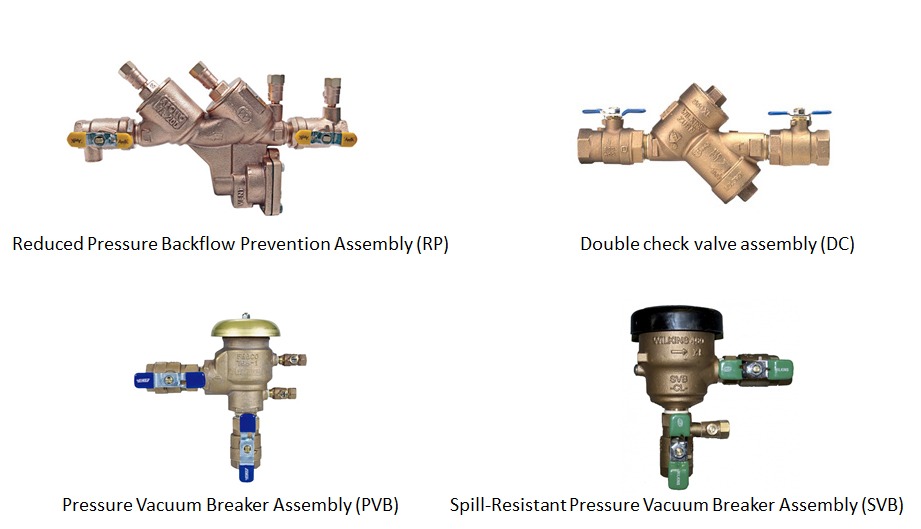
Backflow can be prevented by a mechanical device known as a backflow-prevention assembly, such as Double Check Valve Assembly (DC); Reduced Pressure Principal Assembly (RP); Pressure Vacuum Breaker Assembly (PVB); Spill Resistant Pressure Vacuum Breaker (SVB); and Air Gap (AG). Backflow prevention assemblies are effective at preventing backflow but only if the installation criteria are followed. The type of assembly needed is based on the degree of hazard to the portable water system.
|
What is a Backflow Prevention Assembly?
A backflow prevention assembly is an approved, testable assembly which uses valves, in different configurations, to prevent polluted or contaminated water from reversing direction and flowing backward into the potable water system.
|
How are Backflow Prevention Assemblies Aproved?
For a backflow prevention assembly to be approved, the device must go through an approval process at the Foundation for Hydraulic Research and Cross Connection Control at the University of Southern California (USC). This is a two-step process consisting of laboratory tests and a twelve-month field test. Only assemblies approved by the USC Foundation for Cross-Connection may be used in Carefree.
|
Who is Required to Have a Backflow Prevention Assembly?
Any water customer with a cross-connection is required to install appropriate backflow prevention. Federal and State law require that water suppliers protect their water from contamination by requiring the installation and testing of appropriate backflow prevention assemblies. Single family residences used solely for residential purposes are generally exempt from backflow assembly requirements, unless a cross connection has been identified or the residence is used for other purposes. Commercial and industrial customers are required by Arizona Administrative Code R18-4-215 to install, test, and maintain backflow prevention assemblies. When a determination is made by Carefree Water that the potable water system may be subject to contamination through backflow, a backflow prevention assembly will be required to be installed, maintained, and tested. Carefree Water makes these decisions on a case-by-case basis.
|